A Thousand Captives a Year: The Northern Memory of the Dagomba–Asante Treaty
At the Feok Festival in Sandema, a northern Ghanaian author tells Twum Dufe Gabriel how a tribute owed to Asante, and the raiders it fed, shaped the north's past and present.
On festival day in Sandema, in Ghana's Upper East Region, Twum Dufe Gabriel joins a crowd that has come to remember a battle. The occasion is the Feok Festival of the Builsa people. His companion for the day is Ishmael, a student at the Institute of African Studies at the University of Ghana and the author of three novels on the history and cultural life of the northern territories. It is Ishmael's first time taking part in the festival directly, and he has a particular reason for coming: his latest novel, a narrative of slavery in the north, draws on the story the festival commemorates.
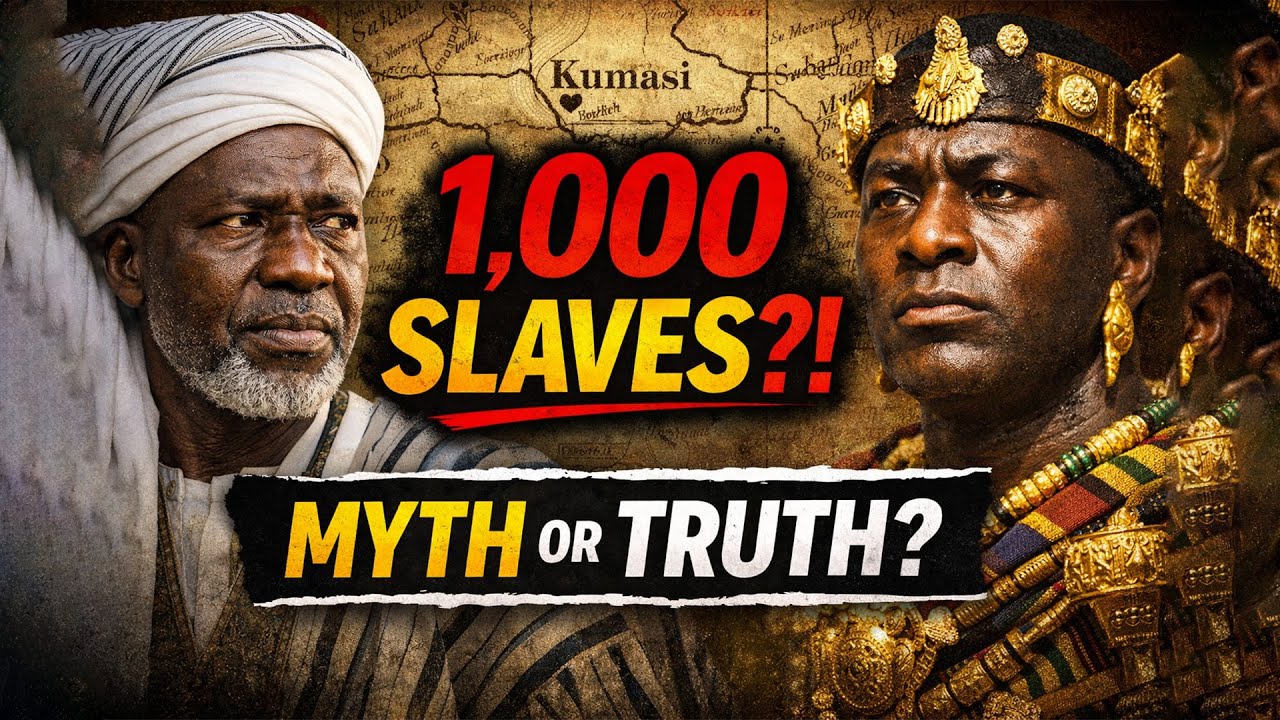
What follows is a long conversation, part history lesson and part argument about the present, in which one claim stands out. The Dagomba kingdom, Ishmael says, was bound by treaty to deliver a thousand captives every year to the Asante state.
A treaty measured in people
Ishmael begins with the wider setting. From the late seventeenth century into the twentieth, he says, the north came heavily under slave raiding and the slave trade. Coastal communities had long been drawn into the business, and some coastal figures became merchants in their own right; he cites the Anomabu trader George Kuntu Blankson. Attention then turned northward.
The reason, in his account, was not that northerners were physically stronger. It was how they lived. Across what are now the Upper East and Upper West regions and part of the North East, he explains, people did not arrive with chiefs. They were organised under clan heads and earth priests, and settled sparsely, clan by clan. Feuds between clans were not unknown. Raiders exploited that gap.
What aggravated the situation, he argues, was the arrangement between Dagbon and Asante. To meet an annual figure of a thousand captives, the Dagomba, in his telling, turned to freebooters such as the Zabarima leader Babatu, with Samori Toure entering the region later. Small, scattered settlements were the obvious targets. Historians generally date Asante's tribute demands on Dagbon to the mid-eighteenth century, while Babatu and Samori were active in the late nineteenth, so the account compresses a long period into a single story.
The day the Builsa turned hunters
One of those raids, according to the tradition Ishmael relates, fell on the Builsa, and it failed. The Builsa did not use guns, so they needed their enemy at close range. Their warriors disguised themselves as animals, wearing horns and carrying skins, and arranged themselves in about three divisions. The raiders walked in among them without realising how near they had come. Then the Builsa cut them down with blades and pierced them with arrows.
The victory is placed at Fiisa, which today hosts a shrine associated with the event. The present chief of Sandema, Ishmael adds, carries the shrine's name as part of his own. The Feok Festival re-enacts that day each year, he says, so that the living generation and those to come can see the bravery and ancestral wisdom of those who fought.
Babatu, Samori and the markets
Twum Dufe Gabriel asks whether these are the same Babatu and Samori linked to the slave camp at Paga, which he has visited before. Ishmael says they are. The camp was a market where anyone capturing, selling or buying could trade, and many of its captives were sent on to Salaga, which he describes as the largest slave market in West Africa in its time. He calls Babatu a Zabarima man from Nigeria; the Zabarima homeland is usually placed in what is now Niger.
The Sissala country, he says, suffered worst. Near Tumu lies Kasana, which he identifies as Babatu's armoury, and another community where a natural tunnel with its own water supply could shelter a whole village for months. Captives taken there were sent to Salaga or to Dagbon.
Many communities claim to have killed Babatu. Ishmael's explanation is that Babatu's force worked like a band of outlaws that anyone could join, and that some of his commanders were local men. When a commander fell, people concluded that Babatu himself was dead. In fact, he says, Babatu's grave lies in Yendi, where there is a mausoleum and a street named after him, and where Ishmael has met his descendants and examined weapons he compared with those kept by the Builsa.
The Gonja, he continues, had little to do with Babatu. Their adversary was Samori, who took part of the kingdom, including Bole, and was stopped only at Busunu, the town where Ishmael, whose mother is Gonja, went to school. He says Samori established himself at Kong, inside what is now Mole National Park, and asserts that the park's name derives from Samori's, a claim he says the archives support but which is not the commonly given explanation. Kong's warriors were seen fighting alongside Samori, and whether they were forced or willing, the Gonja judged it a betrayal and removed Kong from the line of succession to the paramountcy. Ishmael says he has sat with the chief of Kong, who told him his ancestors were never invited to answer the charge.
Partnership or subjugation?
The host raises a question that stirs strong feeling today: were the Dagomba subjects of Asante? Ishmael answers carefully. There are two schools of thought, he says, and the matter is sensitive. What the literature states consistently is that Dagbon entered into a treaty with Asante. Whether it was a partnership or a relationship of domination is the point still open to debate.
He offers one piece of evidence for partnership. The Dagomba call their warrior clan Kambonse, a word that also means Asante. In return for captives, he says, Asante supplied guns, gunpowder and military training, obtained through its access to the British on the coast. He believes some Asante who came to Dagbon never left.
From raiding to the labour pool
The conversation widens to the landscape. Past Sunyani, Twum Dufe Gabriel observes, the country seems to change. Ishmael ties this to history: the savannah suited horses and cattle, the tsetse fly made the forest hostile to them, and the earliest outside influence, as he puts it, came from the Arab world across the Sahara rather than from the sea. The south, in his view, rose only when Europeans arrived on the coast.
Colonial rule then fixed the north's position. Ishmael says the British, finding nothing they wanted to extract there, built neither roads nor railways and treated the north as a reserve of labour for southern cocoa farms and mines. He dates the establishment of cocoa by the British to between 1920 and 1940, with Ghana leading world production by 1960; the standard record credits Tetteh Quarshie with introducing the crop in 1879 and has the Gold Coast leading world output by the 1910s. The demeaning names given to northern labourers then, he says, have a successor in the way young northern porters are spoken of now.
Many northern routes, he argues, are still the old slave paths, merely widened. The host confirms the difficulty: a trip from Accra he expected to take fourteen hours took him twenty-seven. Ishmael also describes maize selling at 250 to 300 cedis a bag, too little to cover a farmer's costs. His remedy is what he calls decolonisation.
We must fish out our own indigenous system of development.
What the raids left behind
Asked what shocked him most in his research, Ishmael names the loss of trust. Clans joined the raiders against their neighbours, and families can still recount who captured whom. Those memories, he says, are kept in the shrines.
One northerner looks like a baobab tree, so strong. You bring two, three northerners and we become weak.
He connects this to chieftaincy disputes. In his account only two groups came to the north with chiefs: the Gonja, and the Mamprusi together with the related Dagomba and Nanumba. Elsewhere authority lay with the earth priest who pours libation at the shrine, and chiefs were introduced under British rule. Where an office has no rooted lineage, he argues, rivals with money or political backing contest it. He touches on Bawku and on clerical families in Gonja only briefly, and the host notes that other explanations are also given. These are contested matters, and Ishmael presents his reading as one view.
He closes with a complaint about how slavery is remembered: historians write of castles and reparations, he says, and forget the hinterland from which the captives were drawn. In Sandema, the Feok Festival is one answer to that silence.
Prefer to watch? This article is based on a Journey documentary. Watch the video →
More in Slave Routes

Slave Routes
The Missing Link: A Danish Plantation on the Road from the North to the Sea
At Sesemi, below the Aburi hills, an elder walks Twum Dufe Gabriel through Frederiksgave: a Danish royal plantation, a slave village, and a list of…

Slave Routes
Guns for Captives: Dagbon, Asante and the Slave Trade of the North
In Yendi, a keeper of Dagomba oral history tells Twum Dufe Gabriel of a guns-for-captives pact with Asante, a royal ban on slave trading, and the…

Slave Routes
At the Grave of Babatu: A Slave Raider Remembered by His Descendants
In the Dagbon kingdom, Twum Dufe Gabriel visits the tomb of the Zabarma warlord Babatu and hears how his family and a local historian remember him.
Discussion 0
No comments yet. Be the first to share a thought.
Join the conversation. Members can comment on every article, video and photo without leaving the site.
Join free Sign in