A True Weight: Akan Gold, Brass Scales and the Coming of the Portuguese
Through the story of a young brass caster, The Journey retells how the Akan weighed their gold with exact brass weights, and how that honest scale met Portuguese ships at Elmina in 1471 and 1482.
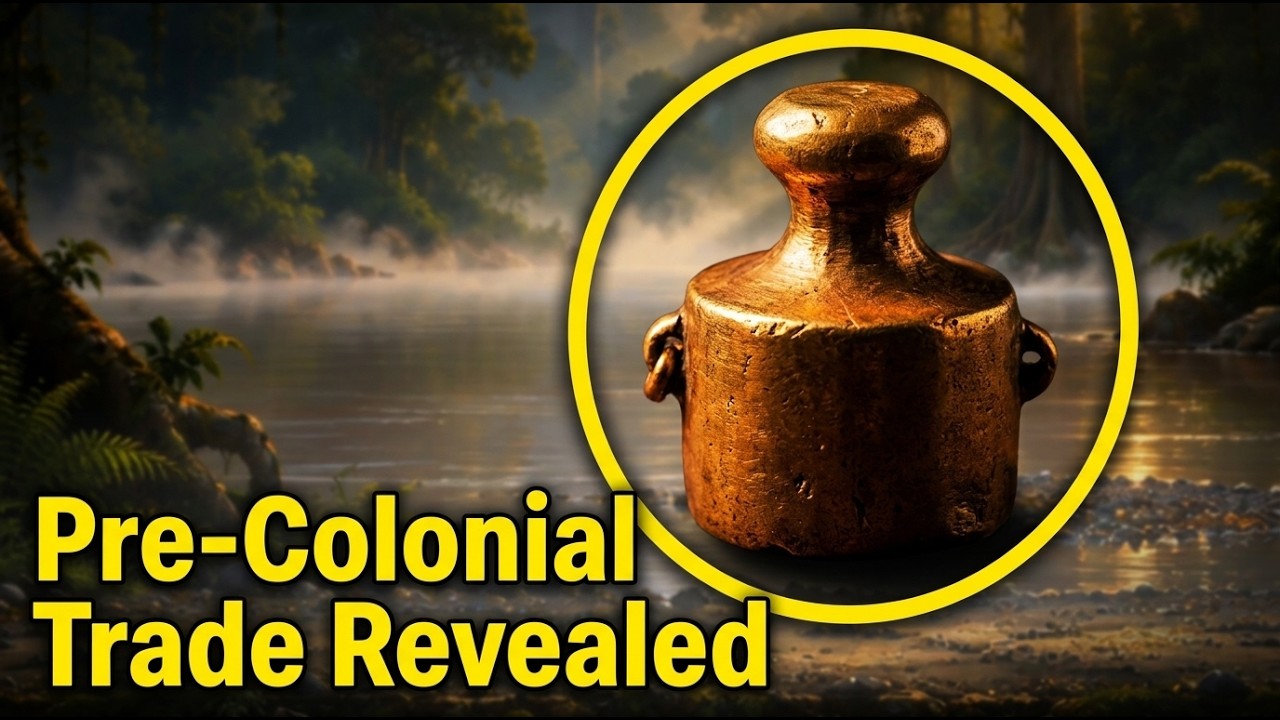
In this film from The Journey, Twum Dufe Gabriel's documentary project sets aside the road and the interview for a different form: a narrated historical story. It follows a young Akan brass caster, his family and a friend on the coast across twelve years, from 1470 to 1482. The household at its centre is presented as a story rather than a record, but the world it moves through is the documented one: the gold of the West African forest, the brass weights that measured it, and the arrival of the first Portuguese ships on the shore that Europeans would come to call the Gold Coast.
Gold measured in brass
The narrator opens with a simple claim. Long before anyone in the forest had heard of Europe, gold was already being panned, dug and traded by the Akan, and every grain of it was weighed. The Akan, the film explains, had no coins. They paid in gold dust, and each pinch was set on a tiny balance against a brass weight. A trader might own hundreds of these weights, cast by hand in the shape of a fish, a pyramid, or a disc marked with lines, and each had to be exact.
The film shows how such a weight was made. The caster, a sixteen-year-old named Kofi, shapes a fish no longer than a thumb out of beeswax and presses scales into it with a thorn. He coats it in wet clay and charcoal, leaving a small channel open, and sets the mould in a clay furnace fed by goatskin bellows. The wax runs out; molten brass is poured into the space it leaves. When the mould is cracked open, the rough casting is scrubbed with sand until it shines. This is the technique known as lost-wax casting, and Akan gold weights made by it are held today in museum collections around the world.
Then comes the test. Kofi's maternal uncle, a trader named Kwadwo, places the new fish on one pan of his balance and a trusted weight on the other. The fish is heavy by a grain. A grain today, he says, is a handful of gold over a year, and he sends it back to be filed.
“A weight that lies makes the man who uses it a liar.”
A town in the gold forest
Around this lesson the film sketches the workings of an Akan town. Kofi's sister Abena pans river gravel in a wide wooden bowl and finds a nugget the size of a fingernail. She does not keep it. Large pieces of gold, the narrator explains, belonged to the stool, the seat of the town's power and of its ancestors. She carries it to their grandmother, the queen mother, who helped to choose the chief and could rebuke him. The old woman accepts the nugget and returns a fleck of gold to the girl, so that an honest hand does not stay empty.
The film notes that in Akan families a child belonged to the mother's line, which is why a mother's brother held such authority. It also shows where the gold went. A Mande trader from the north arrives with donkeys loaded with slabs of desert salt. He and Kwadwo lay their two sets of weights against each other, find that they agree, and only then do business. Some of the gold carried north in this way, the narrator says, crossed the Sahara on camels and ended up in the coins of Europe. The trader also brings news: fishermen far away by the sea speak of pale strangers in wooden houses that float, who ask in every port for one thing.
The road to the sea
Kwadwo decides to take gold south and to bring the boy who makes his weights. Before they leave, the queen mother asks Kofi what he gives a stranger. Water and a seat, he answers. And what does he keep? His own scale, she tells him.
The journey to the coast is on foot, in single file beneath the great trees. There were no horses or carts in the forest, the narrator observes; everything moved on human heads. Every road belonged to someone, and at a town gate Kwadwo pays a toll in carefully weighed gold dust. By the fire one night he explains why a grain matters: a trade is two strangers trusting a piece of brass, and if the brass is not honest, nothing else is.
They reach the Fante coast near the mouth of the Pra River, among fishermen and traders whose language is close to their own. There Kofi tastes the sea for the first time and makes a friend, a fearless young canoeman.
1471: ships on the horizon
In January 1471, the film recounts, a talking drum wakes the town. Two tall ships stand offshore. They are Portuguese, sent by a Lisbon merchant who had bought the right to trade along the coast, and their captains are João de Santarém and Pêro Escobar. According to the narrator, no European had reached this shore before. The chief orders that nobody paddle out: if the strangers want something, they can come to the beach.
They do, offering a brass basin and red cloth and pointing at the chief's gold. In the film's telling, the lead sailor weighs the gold on his own balance against his own iron weight. Kwadwo sets that iron weight on his scale against Kofi's brass fish, and the iron rises. It is lighter than it claims to be. There is a tense moment, a hand on a sword and a quiet line of young men with spears, before the sailor laughs and gives way. The trade goes on with Akan weights. Kofi notices how the strangers' eyes follow every grain, and he notices the cannon along the ship's side. Back home he casts a small brass ship, checks it ten times, and is told by his grandmother to keep it for the day he needs to remember what a true weight is.
1482: stones carried across the ocean
Eleven years later Kofi, now a trader himself, is called to Elmina, a larger town on a rocky point where a lagoon meets the sea. A fleet of ten or more ships lies offshore. King João II of Portugal has sent a nobleman, Diogo de Azambuja, with about 600 men, soldiers and masons among them, and cut stone, timber and lime. These visitors, Kofi's friend observes, do not mean to trade and leave.
The film stages the meeting that Portuguese records describe. After mass is said beneath a great tree, the ruler of Edina, Nana Kwamina Ansa, whom the Portuguese called Caramansa, arrives under a state umbrella with drummers, horn blowers and sword bearers. Through an interpreter, Azambuja asks permission to build a house to protect his goods, and speaks of his king's hope that the chief will accept the Christian faith. The reply, which the narrator stresses comes from the Portuguese written account, is cautious. Earlier visitors came, traded and left, and so friendship lasted.
“Neighbors living fence to fence find reasons to quarrel.”
With ships and armed soldiers before him, the ruler gives his consent, reminding the newcomers who granted the ground. The next day masons begin breaking a dark rock on the point that the people of Edina held sacred as the house of a god. A priestess is pushed aside, a fight breaks out, and blood is shed before Azambuja calls his men back and sends basins, cloth and beads to the elders. Kofi's judgment is brief: “The scale is wrong.”
What the scale came to weigh
The film closes with the longer record. The Portuguese named their fortress Saint George of the Mine. Known today as Elmina Castle, it is often described as the oldest European building in Africa south of the Sahara. For about a century it traded mainly in gold, though the narrator notes that even in the first years Portuguese ships brought captives from other shores and sold them there. The Dutch took the castle in 1637, and by then the trade was in human beings. Captives were held in its dungeons and led through a narrow door to the ships; most never saw home again.
Forts spread along the coast. In 1874 Britain declared the Gold Coast a colony, and in 1957 it won independence as Ghana. Through all of it, the narrator says, the peoples of the forest, the coast and the north kept their languages, their kingdoms and their faiths. The castle still stands on its rock, and the brass weights still sit in museum cases, small and exact.
Prefer to watch? This article is based on a Journey documentary. Watch the video →
More in Culture & Traditions

Culture & Traditions
Queens of the Cloth Trade: The Nana Benz of Togo
In a Lomé museum, Twum Dufe Gabriel meets the cloth traders remembered as the Nana Benz, hears a Togolese account of kente, and finds a fabric…
Culture & Traditions
Not Pagan, Not Demonic: A Scholar's Case for African Traditional Religion
At the University of Ghana, Twum Dufe Gabriel asks a student of African traditional religions how Ghanaians worshipped before church and mosque, and…

Culture & Traditions
Between Sea and Lagoon: The People of Keta and the Words They Carry
At Fort Prinzenstein, a Keta historian traces Anlo-Ewe identity through borrowed Danish words, a migration tradition from Notsie, and borders that…
Discussion 0
No comments yet. Be the first to share a thought.
Join the conversation. Members can comment on every article, video and photo without leaving the site.
Join free Sign in