Beneath the Lake: Krachi's Drowned Slave Market and the Memory of German Rule
In Kete-Krachi, a chief who grew up in the old town points across the Volta Lake to where a slave market once stood, and recalls what his elders said of the German years.
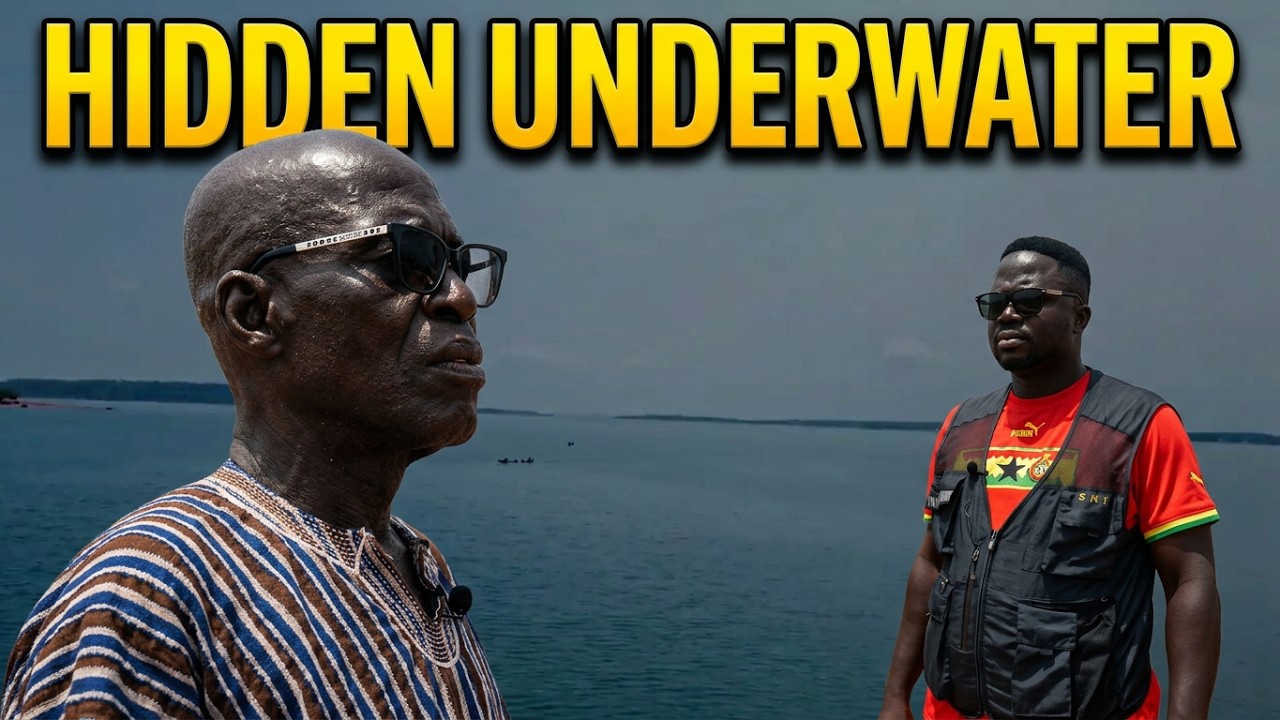
There is nothing to visit. That is the first thing Twum Dufe Gabriel tells his viewers when he arrives in Kete-Krachi, in Ghana's Oti Region, on his journey northwards along the old slave routes. No walls, no dungeon, no memorial. The place he has come to find lies under the Volta Lake. What remains is memory, and the man who carries it: a chief of Krachi who was a schoolboy in the old town before the water came.
Standing at the lakeside, with a ferry loading vehicles behind them, the chief uses the shoreline as a measuring point. The road that once led into the township, he explains, ran straight out into what is now open water. From there he rebuilds the vanished town by pointing.
A town drawn from memory
Some five or six hundred metres out, the chief says, there was a roundabout. To the left stood Victory Park and the road to the old barracks and the bungalows where the administrators lived. To the right, past a community centre, lay the food market, the lorry station and the stalls where cloth was sold, all gathered in one area. Further on there was a barrier and then an airstrip. The prisons stood on another side of town, and he points to what he says is part of an old building still visible from the shore.
Beside the food market, he recalls, stood a large baobab tree, already dead in his childhood. It was there, he says, that the shackles were kept. Market days were Mondays and Thursdays, and because their grandfathers told them stories of the slave trade, he and other children went to look for themselves.
"I could still remember the shackles."
Had the town not been flooded, he believes, the baobab would still be standing. He attended all six years of primary school in the old town and was approaching middle school when it was lost, more than sixty years ago by his reckoning.
A station on the road from Salaga
According to the chief, Krachi was one link in a longer chain. Captives were brought from the Salaga area, he was told, and from Krachi they were sent on to the south. The drive to Salaga today takes about three hours; on foot, over the rough roads of the time, he estimates a day or two of walking. How they continued from Krachi he cannot say with certainty. The river was far narrower then, with two tributaries joining nearby, and his elders spoke of fishing people who came by boat, but he is careful not to claim more than he knows.
He is equally careful about who was responsible. The slave trade as it was described to him was not the work of the Germans, he says, but was carried on by local people themselves, moving captives from north to south, with buyers he presumes were Arabs working alongside local collaborators. His parents also told him that a person judged very stubborn could simply be sold.
Asked why Krachi mattered, he describes it as a special, well-planned town in its day, with prisons, a barracks and banks, and with the main road from the north to Accra passing through it over a bridge not far away.
What the elders said of the Germans
The heaviest part of the conversation concerns German rule. Twum Dufe Gabriel admits that he grew up knowing Ghana as a British colony, and the chief explains that this part of the country belonged to Togoland and joined Ghana only after a referendum.
The chief did not live through the German period; he repeats what he was told. In that account the Germans ruled as an autocracy. People lived in fear and could be made to carry loads or do whatever was demanded. Soldiers from the barracks could arrest someone on mere suspicion, and hangings were easily ordered. Some people fled.
Tradition in Krachi holds, he says, that the Germans were displeased with local religious practice and hanged traditional priests in the market itself. He puts the number at three at first, and says that others later escaped or took their own lives rather than face the disgrace. He asks in what court these men were ever tried.
He also recalls a story about a German governor stationed both at Krachi and at Lomé. When the official travelled he rode a horse, the chief was told, while young men were summoned in each village to carry his loads to the next, village after village, as far as the Togo border.
The chief places the German departure after the Second World War. The established record puts it earlier: German Togoland was occupied by British and French forces in 1914, at the start of the First World War, and the British-administered part voted in a 1956 plebiscite to join what became Ghana. Historical accounts also record the execution of the priest of Krachi's Dente shrine by German forces in the 1890s. Of the British period the chief says only that he has nothing comparable to report.
The flood that took 54 towns
The old town was lost to electricity. As the chief tells it, Kwame Nkrumah wanted more power for the country and reached an agreement with the Kaiser group of America that involved building a dam and smelting metal. The dam is at Akosombo, and the lake behind it spread across the whole area.
People did not believe the warnings, he says. The river was about three kilometres from the township and had never risen anywhere near it. Resettlement sites were built in advance, and still people doubted. When the water came it took them by surprise. In the Krachi and Nchumuru area, he says, about 54 towns and villages went under. Chinderi and a few other places survived. Elsewhere, ten or twelve villages at a time were combined on land acquired by the government.
Families abandoned cocoa farms, palm trees and property, and some were surrounded by the rising water. The military came in to rescue them, and a district of the new town is still called Soldier Camp. The chief has heard that the future head of state, Ignatius Kutu Acheampong, was part of that operation. Later, machines were brought in to clear the stumps of drowned trees that were causing boat accidents.
A peninsula, and a wish to be heard
The lake's effect on the town, the chief says plainly, has been negative. Krachi now sits on a peninsula. Travellers to Accra or Kumasi must wait for the ferry, which does not sail at all hours. Much farmland is gone and many people have migrated. There are no factories, although cassava is widely grown and the lake could irrigate crops; tomatoes, he notes, are brought in from elsewhere to be sold. What development the town has seen, he says, has come "through our own efforts".
There is a second loss. Because the market site cannot be seen, he says, people who speak about the slave routes no longer mention Krachi, though it might have drawn visitors as Salaga does.
His closing words return to the German years. The grandchildren of the hanged priests are still living in Krachi, he says. He calls what was done an insult that remains an insult, believes his people should be compensated, and wishes he could say so to the German ambassador in person. He hopes that if his own generation does not see the story told, the grandchildren will take it up.
Twum Dufe Gabriel leaves without having seen the site he came for. He has only the picture the chief drew in the air: a roundabout, a market, a dead baobab. From here the journey continues towards Salaga and Pikworo.
Prefer to watch? This article is based on a Journey documentary. Watch the video →
More in Colonial Era
Colonial Era
On Forbidden Ground: Kwame Nkrumah and the End of Colonial Rule in Ghana
At the Kwame Nkrumah Memorial Park in Accra, a guide walks Twum Dufe Gabriel through the life, the overthrow and the three burials of the man who…
Colonial Era
Cross and Crown: The Church, the Colonial State and the Cathedral at Navrongo
In conversation with a researcher friend, Twum Dufe Gabriel weighs how far Christian missions shared in slavery and colonial rule, through the story…

Colonial Era
One Thread, Three Eras: Ernesto Yeboah on Slavery, Colonialism and Neo-Colonialism
After a year of visiting forts and slave markets, Twum Dufe Gabriel sits down with Nkrumaist organiser Ernesto Yeboah to ask what connects slavery,…
Discussion 0
No comments yet. Be the first to share a thought.
Join the conversation. Members can comment on every article, video and photo without leaving the site.
Join free Sign in