On Forbidden Ground: Kwame Nkrumah and the End of Colonial Rule in Ghana
At the Kwame Nkrumah Memorial Park in Accra, a guide walks Twum Dufe Gabriel through the life, the overthrow and the three burials of the man who declared Ghana free.
In the middle of Accra, a short distance from the sea, a bronze figure stands with one arm stretched out in front of it. It marks the spot, visitors are told, where Kwame Nkrumah stood on the night of 6 March 1957 and announced that the Gold Coast was now Ghana, and that Ghana was free. Twum Dufe Gabriel has come to the Kwame Nkrumah Memorial Park, completed in 1992 under Flight Lieutenant Jerry John Rawlings, to hear the story from a guide who introduces himself as Kwabena and who has told it many times.
Gabriel lives in Accra and has already visited Nkroful, the village where Nkrumah was born and where he once lay buried. Yet he admits, a few minutes into the tour, that he had always assumed independence was declared at Independence Square. The guide corrects him: it happened here, and the choice of place was deliberate.
A field that was off limits
Before it was a memorial, the guide explains, this ground was a polo park. It was reserved for the British, who came here to play, and Africans were not permitted to enter. Anyone who tried, he says, risked arrest. On our own land, as he puts it, people could not set foot on this field.
That, in the guide's account, is why Nkrumah chose it. The place Africans could not touch would be the place where their freedom was announced. Gabriel calls the decision strategic, and the guide agrees. Today this part of the park is known as the declaration grounds. Behind the statue, the park has preserved the original metal platform on which Nkrumah and his colleagues stood that night; it was moved a short distance when the statue was installed and is kept, the guide says, so that young people can see it for themselves.
The statue points straight ahead, and the guide ties the gesture to Nkrumah's well-known phrase:
“We face neither East nor West; we face forward.”
From Nkroful to the Legislative Assembly
The guide then goes back to the beginning. Nkrumah grew up in Nkroful, in the west of the country. His mother was a petty trader and he was her only child; his father, the guide says, was a goldsmith at Half Assini who died when the boy was about four. It fell to his mother to raise him, and she enrolled him in a Roman Catholic elementary school. He took to learning, and by sixteen, in 1926, he was a pupil teacher in the same school.
From there the guide traces a steady path outward: Achimota for teacher training, then in 1935 the voyage to the United States and Lincoln University in Pennsylvania, where he struggled financially until he won a scholarship and completed his degrees. A short period at the London School of Economics followed. While abroad, the guide says, Nkrumah played a significant part in the Pan-African meeting held in Manchester, and his name began to travel.
It reached the leaders of the United Gold Coast Convention, who invited him home in 1947 to be their general secretary. The following year the British arrested the party's leaders. After their release, Nkrumah broke away and in 1949 founded his own Convention People's Party. His purpose in returning, the guide says, had always been twofold: to win independence, and to unite Africans across their borders.
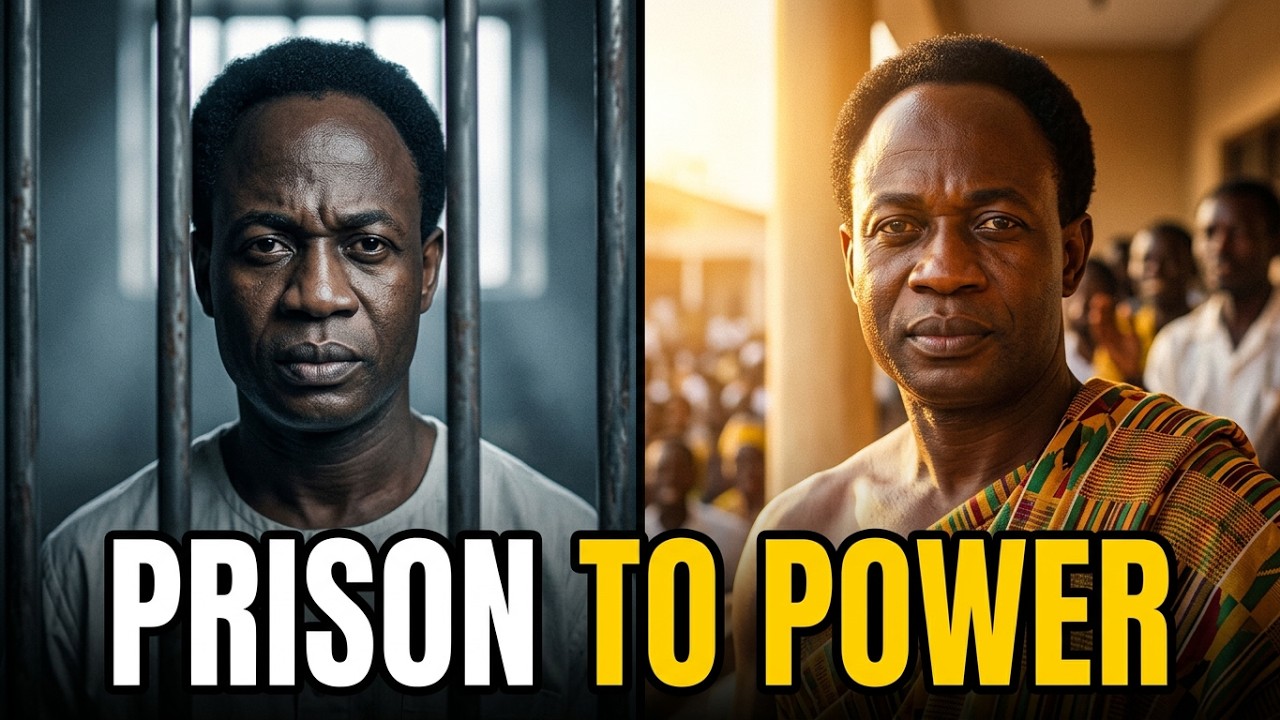
The colonial authorities arrested him again and sentenced him to three years for his political activities, holding him at James Fort prison in Accra. He served just over a year. While he was still in his cell, elections were held for the Legislative Assembly, and by the guide's count his party won 34 of 38 seats. Nkrumah was taken from prison to head the government, a position the guide describes as equivalent to prime minister. The guide dates this election to 1952; the established record places the vote in February 1951, with the title of Prime Minister following in 1952.
A new name, and symbols in bronze and marble
With independence came a new name. The guide explains that “Gold Coast” told the world only what could be taken from the land, and that Nkrumah wanted a name that spoke of its people. He chose Ghana, after the ancient empire of West Africa. Gabriel adds a tradition he has heard, that the Akan are descended from people of that old empire who later migrated south; it is offered as tradition, not as settled history.
Nothing in the park, the guide insists, is there by accident. At the fountains, bronze figures represent the old ways of carrying news: for the south, the fontomfrom drums that summoned people to the chief's palace; for the north, a figure in the smock known as fugu. Seven horn blowers kneel in the water, one for each day of the week, sounding without rest the news that the leader lies behind them. The water itself stands for life. Ghanaians, the guide says, still believe Nkrumah lives among them.
Nkrumah and his colleagues wore northern smocks on independence night. The guide's explanation is that they had been held in prisons in the north, moved from place to place because the British feared crowds would break them out, and that a northern chief gave them smocks to cover their soiled clothes on release. This sits uneasily with the established record, in which Nkrumah had been out of prison and leading the government for several years by 1957; his detention in the north dates to 1948.
The mausoleum was designed by Don Arthur, whom the guide praises as one of Ghana's finest. Clad in Italian marble, it is shaped like a tree whose trunk has been cut short, because Nkrumah's vision was cut short. Its edges suggest swords turned upside down, a sign of peace. The star at its summit recalls Ghana as the first country south of the Sahara to gain independence. Around the grounds stand trees planted by visiting leaders, each with a name plate. One mango tree was planted by Nelson Mandela in November 1991; the guide describes him as South Africa's president at the time, though the plaque gives his office as President of the African National Congress, and he did not become head of state until 1994.
Overthrow and exile
On 24 February 1966, while Nkrumah was travelling to Hanoi, soldiers and police seized power in Accra. The guide names Emmanuel Kotoka and Akwasi Afrifa among the leaders, and says they would not have dared to act while Nkrumah was in the country. The complaint against him, as the guide has read and heard it from elders, was that he was spending Ghana's resources on the liberation of other African countries.
A headless, broken statue in the park is the physical record of that day. It once stood in front of the old Parliament House and was attacked by those celebrating the coup. In the guide's telling, a woman carried the head away and hid it, at a time when being found with anything belonging to Nkrumah was dangerous. She kept it for 43 years and returned it through the information ministry in 2009. Her name has never been made public.
Gabriel raises the long-standing claim that the United States Central Intelligence Agency was behind the coup. The guide thinks it could well be true, notes that a Ghanaian president has said as much, and places Nkrumah alongside Patrice Lumumba and Thomas Sankara as leaders who were removed. But he keeps returning to a harder point: outside powers, in his view, work through local people who are offered what they want. Kotoka himself was shot the following year, and the international airport in Accra bears his name; the guide says no one knows who killed him, though the historical record attributes his death to an attempted counter-coup in April 1967.
Nkrumah did not return. He was received in Guinea, whose independence in 1958 the guide credits in part to his ideas, and President Sékou Touré named him co-president. The guide reads his decision not to fight his way back as the choice of a man of peace.
Buried three times
Nkrumah died on 27 April 1972 in Bucharest, Romania, where the guide says he had gone for treatment for prostate cancer. He was given a state burial in Conakry. His mother, by then more than a hundred years old and blind, asked for her son's body, and with the involvement of Ghana's military government it was released about three months later. Embalmed and placed in a metal coffin, he was laid to rest in Nkroful, where people travelled from abroad to pay their respects. In 1992 he was moved for the last time, to the mausoleum on the old polo field.
Beside him lies his wife, Fathia, who died in Egypt on 31 May 2007 and had asked to be buried next to her husband. The guide describes the marriage as one arranged by Egypt's President Gamal Abdel Nasser to bind West and North Africa closer together. The couple had three children, Gamal, Samia and Sekou; Samia later sat in Ghana's parliament. Nkrumah also had an older son from an earlier relationship.
What the guide takes from it
Near the end, Gabriel asks what years of telling this story have done to the man telling it. The guide answers that he wishes Nkrumah were president today, and lists what he regards as the inheritance: electricity, the Tema motorway, the Adomi bridge, the university of science and technology in Kumasi, factories. Asked whether independence has delivered real freedom, he is less sure. He speaks of talented young people leaving on scholarships and visas and not returning, and of officials who pocket funds meant for others. These are his opinions, and he offers them plainly: the damage, he argues, is mostly done by one's own.
The tour closes on a line displayed at the memorial, which the guide attributes to Nkrumah and repeats twice:
“I am not African because I was born in Africa, but because Africa was born in me.”
Nkrumah has died, the guide tells the camera, but Ghanaians still feel him beside them. In this park, the water around the tomb says the same thing.
Prefer to watch? This article is based on a Journey documentary. Watch the video →
More in Colonial Era
Colonial Era
Beneath the Lake: Krachi's Drowned Slave Market and the Memory of German Rule
In Kete-Krachi, a chief who grew up in the old town points across the Volta Lake to where a slave market once stood, and recalls what his elders said…
Colonial Era
Cross and Crown: The Church, the Colonial State and the Cathedral at Navrongo
In conversation with a researcher friend, Twum Dufe Gabriel weighs how far Christian missions shared in slavery and colonial rule, through the story…

Colonial Era
One Thread, Three Eras: Ernesto Yeboah on Slavery, Colonialism and Neo-Colonialism
After a year of visiting forts and slave markets, Twum Dufe Gabriel sits down with Nkrumaist organiser Ernesto Yeboah to ask what connects slavery,…
Discussion 0
No comments yet. Be the first to share a thought.
Join the conversation. Members can comment on every article, video and photo without leaving the site.
Join free Sign in